Product overview


Mechanical position indicators are characterized by a simple design and long service life. Unlike more modern electronic devices, they do not require access to a power source. Measurement accuracy is not as precise as with electronic indicators, but it falls within the range of 0.1 to 1 mm, which is fully sufficient for many manually or mixed-controlled applications. In addition, the risk of failure of a mechanically driven device is much lower, and another advantage is its more favorable price.
Position indicator with direct drive
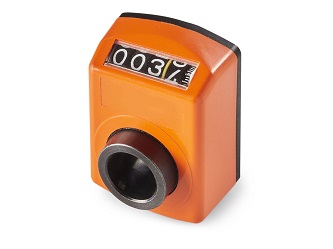
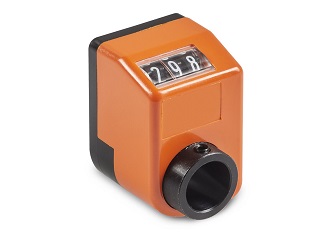
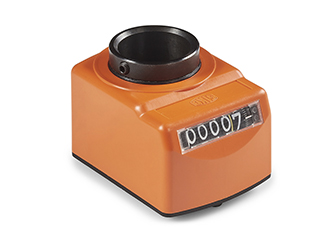
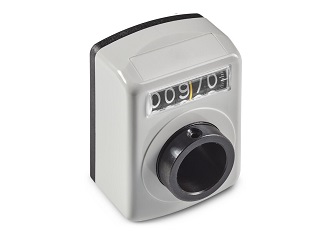
The device is mounted directly on the machine control shaft by connecting the spindle to the indicator bushing. Rotation of the shaft sets the bushing in motion, and a system of gear transmissions converts the rotary movement of the bushing into the digital readout of the counter. The counter reading increases by a previously defined transmission value after one full rotation of the shaft, either clockwise or counterclockwise. The indicator can be mounted in any position. The transmission value in a direct-drive indicator is the number by which the counter reading increases after one full rotation of the shaft (360°).
Revolution indicator with gravity drive
This model does not have direct contact with the shaft; it is mounted in a control element installed on the shaft. Such an element may be a special handwheel or a knob with a seat for a gravity-driven indicator. The device mechanism uses gravity: a weight mounted inside causes the pointers to move when the wheel or knob rotates. For this reason, gravity indicators may only be installed in a vertical position. In a gravity indicator, the transmission value is the number of turns that must be made with the handwheel or knob for the pointer to complete one full revolution (360°).
Applications of position and revolution indicators
Position and revolution indicators are widely used in the machinery industry for monitoring the production process. They are often part of production lines, belt conveyors, packaging machines, or labeling equipment. Measuring instruments are also commonly mounted in all kinds of machine tools for wood, metal, and plastics.